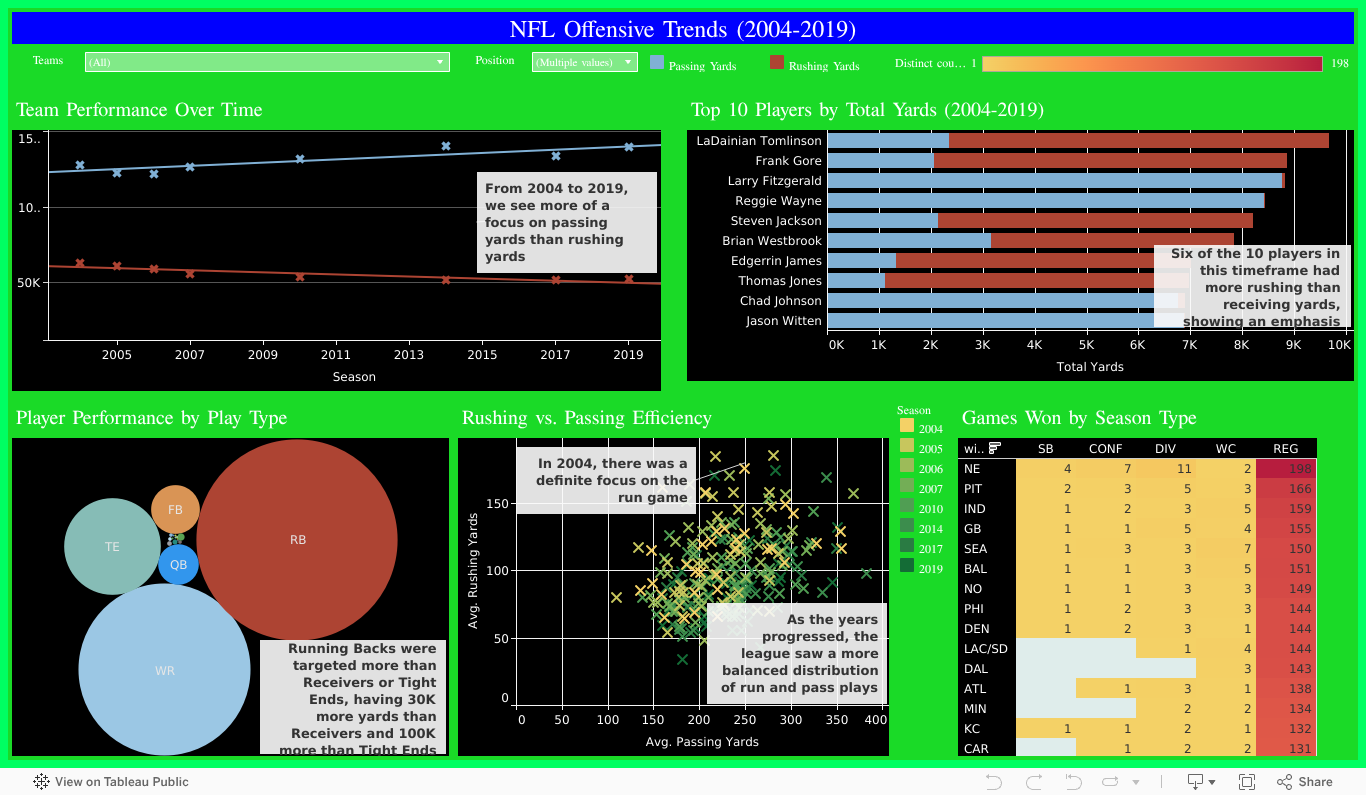
The purpose of this analysis is to examine what makes an NFL player and team productive by looking at NFL datasets that span from 2004-2019. The two datasets that used were the NFL Player Data from Kaggle and the nflverse data repository from GitHub.
Tools and Steps
The 5 datasets that were pulled from Kaggle were downloaded into Google Sheets and Excel where they were cleaned and re-formatted.
Once the individual datasets were cleaned, they were uploaded into BigQuery to join the five tables together to create one table with the players, teams, and their stats. I also created secondary queries to create tables that looked at specific aspects of the data to answer the purpose of the analysis.
Once I had created all the tables I needed, they were brought them into Excel to create a data source for my Tableau visualizations. I decided to create 4 visualizations: a bar graph and a heatmap that looked at player performance based on 'air' and 'ground' yards; and a bar graph and a combo plot grpah with trend line that looked at team performance based on plays and yards.
After creating the visualizations, I brought in the combined dataset to do an analysis by using R programming.
Findings
Analysis of NFL Offensive Trends (2004-2019)
This analysis examined NFL offensive trends from 2004 to 2019, focusing on the balance between rushing and passing. Key findings include:
Shift from Rushing to Passing: The early 2000s emphasized rushing, with running backs accumulating more yards and dominating the top player rankings (e.g., LaDainian Tomlinson, Frank Gore). However, a clear trend emerged towards passing offenses. Average passing yards per game increased, while average rushing yards decreased.
Team Success vs. Individual Yardage Leaders: Interestingly, the top five most successful teams during this period (including the New England Patriots) did not necessarily feature players who ranked high in individual yardage. This suggests that overall team strategy and performance may not always correlate directly with individual player statistics.
Implications for Team Management: These findings highlight the dynamic nature of NFL offenses. While individual talent remains important, a successful team requires a well-balanced strategy that adapts to evolving league trends. General managers should prioritize building a versatile roster and coaching staff capable of excelling in both rushing and passing.
This analysis provides valuable insights into offensive trends in the NFL, emphasizing the shift towards passing and the complex relationship between individual player performance and team success.
Further Questions
Deeper Dive into the Passing Trend:
What specific factors contributed to the shift towards passing? Are rule changes favoring passing offenses? Has the athleticism of quarterbacks and receivers increased, making passing more effective? Are there coaching or schematic trends driving this change?
How has the increased emphasis on passing affected defensive strategies and player roles? Have defenses adjusted with more defensive backs or different schemes?
Are there specific types of passing plays that have become more prevalent (e.g., short passes, deep passes)? How has this changed over time?
Team Success and Player Performance:
Beyond the top 5 teams, is there a stronger correlation between team success and individual player yardage when looking at a larger sample size?
What other factors, beyond individual yardage, contribute to team success in the NFL? (e.g., coaching, turnovers, special teams play, player health).
Are there specific player positions or skillsets that have become more valuable in the passing era?
Impact on Player Evaluation and Draft Strategies:
How should scouting and player evaluation methods adapt to reflect the changing offensive landscape?
Has the NFL Draft seen a shift in prioritization of positions (e.g., quarterbacks, wide receivers) due to the increased emphasis on passing?
How can teams best identify and develop players who can thrive in modern NFL offenses?
Long-Term Trends:
Is the trend towards passing likely to continue, or might there be a resurgence of rushing in the future?
How might future rule changes or innovations in coaching affect the balance between rushing and passing?
By exploring these additional questions, you can gain a more comprehensive understanding of the evolving NFL landscape and its implications for team management, player evaluation, and the future of the game.